Divya Katha
The Sundar Kand (सुंदरकांड) is the fifth book of the Ramayana, in which Hanuman leaps across the ocean to Lanka, finds Sita in the Ashoka grove, gives her Rama's ring, burns Lanka and brings back the news that she is alive. Its lessons are about courage, humility, clear thinking and devotion: Hanuman succeeds not only because he is strong, but because he uses his strength with wisdom and gives the credit to Rama.
It is the fifth book of both Valmiki's Sanskrit Ramayana and Tulsidas's Awadhi Ramcharitmanas, and it is the part of the Ramayana most often read aloud at home, because it is the part where hope returns.
Sundarkand in short (संक्षेप में)
सुंदरकांड रामायण का पाँचवाँ कांड है। जाम्बवान के याद दिलाने पर हनुमान जी समुद्र लांघकर लंका पहुँचे, रास्ते में मैनाक, सुरसा और सिंहिका की परीक्षा पार की, और अशोक वाटिका में माता सीता को खोज निकाला। उन्होंने सीता जी को श्रीराम की अंगूठी दी और बदले में उनकी चूड़ामणि ली। रावण की सभा में पूँछ में आग लगाए जाने पर हनुमान जी ने लंका दहन किया और लौटकर श्रीराम को सीता जी का समाचार सुनाया। यह कथा साहस, विनम्रता, बुद्धि और भक्ति की सीख देती है।
Where the Sundar Kand begins
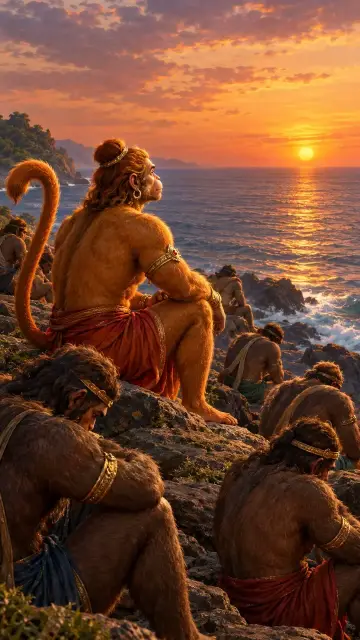
At the end of the Kishkindha Kand, the vanaras sent south to find Sita stand at the edge of the ocean, unable to cross. Hanuman sits silent; he has forgotten his own strength, because of a curse laid on him in childhood by sages he had pestered, that he would remember it only when reminded. The old bear Jambavan reminds him who he is. Hanuman grows in size and climbs Mount Mahendra. The Sundar Kand opens with the leap.
Sundarkand ki kahani: what happens in the Sundar Kand?
Three tests over the ocean
On the way, three things stop him:
- Mainaka, a mountain rising from the sea, offers him a place to rest. Hanuman touches it with respect and moves on. In the Ramcharitmanas he says: राम काजु कीन्हें बिनु मोहि कहाँ बिश्राम, how can I rest before Rama's work is done?
- Surasa, mother of serpents, sent by the devas to test him, blocks his way and says he must enter her mouth. As she opens her jaws wider and wider, Hanuman grows to match, then suddenly becomes tiny, darts in and out, and bows to her. She blesses him.
- Simhika, a demoness who seizes flying creatures by their shadow, catches him. This time Hanuman fights and kills her.
The search in Lanka
He reaches Lanka at dusk, shrinks to the size of a cat and slips into the city at night. In the Ramcharitmanas he first meets the guardian Lankini, who recognises after his blow that Lanka's end is near, and later the righteous Vibhishana, Ravana's brother.
He searches palace after palace. In Valmiki's telling, he sees Ravana's queen Mandodari asleep and for a moment rejoices, thinking it is Sita, then corrects himself: Sita, separated from Rama, would not be sleeping in comfort and finery.
Sita in the Ashoka grove
At last he finds Sita in the Ashoka Vatika, thin and grieving, guarded by rakshasis. Hidden in a tree, he watches Ravana come and threaten her, and watches her refuse him. Then, so as not to frighten her, Hanuman softly recites Rama's story from the branches before he shows himself. He gives her Rama's ring as proof. She gives him her chudamani, a jewel from her hair, to carry back.
Hanuman offers to carry her to Rama on his back. Sita declines: she wants Rama himself to come and rescue her, as is fitting.
Hanuman before Ravana
Before leaving, Hanuman decides to test the enemy's strength. He wrecks the grove, defeats the soldiers sent against him, and kills Ravana's son Akshaya Kumara. Indrajit binds him with the Brahmastra, and Hanuman, out of respect for Brahma, lets himself be taken to Ravana's court. There he speaks calmly, advising Ravana to return Sita and save himself. Ravana orders his death; Vibhishana reminds him that an envoy must not be killed. So instead they set his tail on fire.
Hanuman Lanka dahan: the burning of Lanka
Hanuman leaps from roof to roof and sets the city ablaze. Then a terrible fear strikes him: what if Sita was harmed? He rushes back and finds her safe. Only then does he leap home across the ocean, and his first words to the waiting vanaras, in Valmiki's telling, are simply that he has seen Sita.
What are the lessons of the Sundar Kand?
- Finish the work before you rest. Mainaka's offer was kind and Hanuman's refusal was polite. Rest is good; rest before the job is done can cost everything.
- Strength is not the only answer. With Surasa he used wit, with Simhika force, before Ravana words. Knowing which a moment needs is wisdom.
- Check what you think you see. Hanuman's mistake with Mandodari lasted a moment because he reasoned instead of rushing.
- Give hope before you give news. He began with Rama's story so Sita would trust him before she saw him.
- Respect the other person's choice. He could have carried Sita away. He accepted her decision.
- Humility in success. Asked how he did it, Hanuman gives the credit to Rama. In the Ramcharitmanas, when Rama praises him, he falls at Rama's feet.
- Sometimes you need someone to remind you of your strength. Without Jambavan, there is no leap. Be a Jambavan for someone.
Why do people read the Sundarkand path?
Many families read the Sundar Kand on Tuesdays and Saturdays, at the start of a new venture, or in hard times. The reason is in the story itself: it begins with an army that has lost hope at the edge of an ocean and ends with the news that what was lost has been found. A Sundar Kand path (पाठ) at home, often from the Ramcharitmanas, can take a few hours. Read slowly, one episode at a time, its lessons last much longer.
Watch the story in one minute a day
Hanuman's story is told in his own voice as one-minute Hindi episodes in the Divya Katha app, each one a small lesson in courage and devotion. For more stories that teach children to believe in themselves, see Indian mythology stories for kids, and for Krishna's teaching on doing your work without clinging to its fruit, which Hanuman lived, read Bhagavad Gita lessons for daily life.
Questions people ask
What happens in the Sundar Kand?
Hanuman leaps across the ocean to Lanka, passes the tests of Mainaka, Surasa and Simhika, searches the city by night, finds Sita in the Ashoka grove, gives her Rama's ring, is captured and brought before Ravana, sets Lanka on fire with his burning tail, and returns to Rama with Sita's jewel and the news that she is alive.
Why is it called Sundar Kand?
Sundara means beautiful. A traditional explanation is that everything in this book is beautiful, the hero, the news of Sita and the hope it brings. Another explanation connects the name to Hanuman himself, whose mother is said to have called him Sundara.
Why do people read the Sundar Kand?
Many families read or recite the Sundar Kand, especially on Tuesdays and Saturdays or before a difficult undertaking, because it is the part of the Ramayana where hope returns. Its hero succeeds through courage, devotion, intelligence and humility.
Is the Sundar Kand in the Valmiki Ramayana or the Ramcharitmanas?
Both. It is the fifth book of the Valmiki Ramayana in Sanskrit and the fifth book of Tulsidas's Ramcharitmanas in Awadhi. Most Sundar Kand paths at home are from the Ramcharitmanas.
How did Hanuman burn Lanka?
After Hanuman was captured and brought before Ravana, Ravana ordered his death. Vibhishana reminded him that an envoy must not be killed, so the rakshasas set Hanuman's tail on fire instead. Hanuman leapt from roof to roof and set the city ablaze, then hurried back to make sure Sita was safe before leaping home.
Why did Hanuman forget his strength?
As a child Hanuman pestered the sages in the forest, and they laid a curse on him that he would forget his strength until someone reminded him of it. At the edge of the ocean, the old bear Jambavan reminded him who he was, and Hanuman made the leap to Lanka.