Divya Katha
Ancient stories like the Ramayana, the Mahabharata and the Puranas still matter because they carry, in a form anyone can remember, the values a culture has tested over thousands of years: courage, truth, devotion, duty, forgiveness and friendship. They tell us where our festivals, names and sayings come from, they give families something to share across generations, and they teach not by rules but by showing people choosing, failing and choosing again.
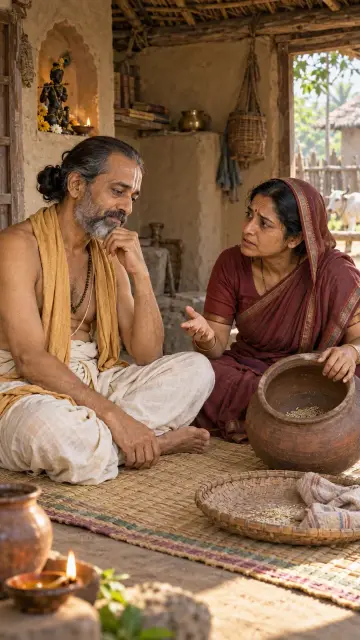
None of this needs a library or a long holiday. These stories were made to be heard a little at a time, and they still work that way.
Pauranik kahaniyon ka mahatva (संक्षेप में)
पौराणिक कथाएं, यानी रामायण, महाभारत और पुराणों की कहानियाँ, हज़ारों साल से साहस, सत्य, भक्ति, कर्तव्य, क्षमा और मित्रता जैसे मूल्य पीढ़ी दर पीढ़ी पहुँचाती आई हैं। ये नियम नहीं सिखातीं, बल्कि दिखाती हैं कि लोग कैसे चुनते हैं, गलती करते हैं और फिर सही राह चुनते हैं। हमारे त्योहार, नाम और कहावतें इन्हीं कथाओं से आते हैं, जैसे होली की आग, दिवाली के दीये और चक्रव्यूह जैसा शब्द। दादी और नानी से सुनी ये कहानियाँ परिवार को जोड़ती हैं, और रोज़ एक मिनट भी इन्हें ज़िंदा रखने के लिए काफ़ी है।
What does itihasa mean?
Indian tradition calls the Ramayana and the Mahabharata itihasa (इतिहास), from iti ha asa: "thus indeed it was". They are not presented as fables with a moral at the end but as the remembered record of an age, told so that later generations could learn from what happened. The Puranas (पुराण), such as the Bhagavata, Vishnu and Shiva Puranas, widen the frame: creation, the avatars of Vishnu, the stories of Shiva and the Goddess, and the lives of kings, sages and devotees across many ages. The Upanishads, though philosophy, also teach through stories: Nachiketa at Yama's door, Satyakama telling the truth about his birth, Maitreyi asking whether wealth can make her immortal.
Why do pauranik kahaniyan still matter today?
1. They teach values by showing, not telling
A rule says "be truthful". A story shows you Satyakama, who did not know his father's name and said so, and was accepted by his teacher because of it. A rule says "do your duty". The Mahabharata shows you Arjuna putting down his bow, and spends the eighteen chapters of the Bhagavad Gita on why he should pick it up again.
The epics are honest about how hard goodness is. Yudhishthira gambles away his kingdom. Bhishma keeps a vow that leads to disaster. Karna is generous and loyal, and on the wrong side. These are not perfect people, and that is exactly why they are useful: we recognise ourselves in their dilemmas.
2. They are made to be remembered
These stories survived for thousands of years largely by being told aloud. The Mahabharata itself says so. It is framed as a recitation: Vaishampayana tells it to King Janamejaya at his great sacrifice, and later the bard Ugrashravas retells it to the sages gathered in the Naimisha forest. The Ramayana is first sung in Rama's own court by his sons, Lava and Kusha.
Stories are built to be carried in memory: a character you care about, a problem, a turning point, a result. A child who will forget a list of virtues by Monday will remember for life how Hanuman forgot his own strength until Jambavan reminded him.
3. They explain who we are
The stories are woven into ordinary Indian life, often without our noticing. Diwali lamps recall Rama's return to Ayodhya. The bonfire before Holi is Holika's fire, which spared Prahlad. On Vat Savitri, women tie threads around a banyan tree for Savitri, who followed Yama. We call an impossible situation a chakravyuh because of Abhimanyu, steady devotion Dhruva because of the boy who became the Pole Star, and a long, searching debate a manthan, a churning, after the churning of the ocean.
Knowing the stories turns these from habits into meaning. A festival you understand is a festival you can explain to your children.
4. They hold families together
For most of Indian history, the first teacher of these stories was a grandparent. A dadi or nani telling the story of Dhruva at bedtime was passing on more than a plot: a voice, a language, a way of seeing the world, and the feeling of belonging to something older than yourself.
That chain is easy to break. Families are spread across cities and countries, grandparents are a phone call away, and evenings are full. The stories do not survive by themselves. Someone has to keep telling them. If you are a parent, there is a simple place to start in our Indian mythology stories for kids.
5. They help in hard moments
People have turned to these texts in difficulty for centuries, not for magic answers but for company. The Sundar Kand is read in homes in hard times because it is the story of hope returning to people who had given up at the edge of an ocean. The Gita begins with a man who is overwhelmed and cannot act. Nachiketa asks the question everyone eventually asks, what happens after death, and gets a serious answer. Stories like these do not remove trouble, but they remind us that others have walked this road before.
How can you learn from these stories when you are busy?
You do not have to read all eighteen books of the Mahabharata at once. The tradition never expected that. Recitations of the epics were spread over days and weeks, a section each evening.
One minute a day sounds like nothing. Over a year it comes to more than six hours: time enough to know the Ramayana and Mahabharata in outline, the great stories of the Bhagavata Purana, and many of the people in them. A little every day also beats a lot once, because a story heard daily stays in the mind and comes back when you need it.
Some ways to make it a habit:
- Pick a fixed moment: with morning tea, on the commute, before sleep.
- Follow one story at a time from beginning to end, so each day connects to the last.
- Tell someone. Retelling a story at dinner is the fastest way to remember it, and the oldest.
- Ask what you would have done. Every story has a choice in it. That question is where the learning happens.
Dharmik kahaniyan in Hindi, one minute a day
This is the idea behind Divya Katha. The app tells stories from the Mahabharata, Ramayana, Bhagavata Purana, Shiva Purana, Devi Mahatmya, the Upanishads and the Bhagavad Gita as short Hindi episodes of about a minute each, many of them in the voice of someone who was there: Hanuman, Lakshman, Vidura, Sanjaya, Savitri, Nachiketa. You swipe up for the next episode, and the app remembers where you left off in each story. You can get it on Google Play and learn a little more each day.
Whether you watch, read or listen, the point is the same as it always was: keep the stories alive by spending a little time with them, and then pass them on.
Questions people ask
What does itihasa mean?
Itihasa comes from iti ha asa, meaning thus indeed it was. It is the traditional name for the Ramayana and the Mahabharata, which are remembered as the history of an age, told so that later generations could learn from it.
What is the difference between itihasa and Purana?
Itihasa refers to the two epics, the Ramayana and the Mahabharata, centred on events and people of one age. The Puranas, such as the Bhagavata, Vishnu and Shiva Puranas, are vast collections of stories about creation, the gods, avatars, kings, sages and devotees across many ages.
Why are mythology stories important for children?
Stories give children values in a form they can remember and repeat: Dhruva's steadiness, Prahlad's faith, Nachiketa's curiosity, Hanuman's courage. They also connect children to the festivals they celebrate and to the grandparents who first told them these tales.
How can I learn the Ramayana and Mahabharata if I am busy?
A little at a time. Read or listen to one episode a day, even a single minute, and talk about it with someone. A minute a day comes to more than six hours of stories in a year, enough to know the great epics in outline and many of their characters well.
What are pauranik kahaniyan?
Pauranik kahaniyan are stories from the Puranas, such as the Bhagavata, Vishnu and Shiva Puranas, and in everyday speech the term also covers stories from the Ramayana and the Mahabharata. They tell of creation, the gods and avatars, kings, sages and devotees, and each carries a value such as courage, truth or devotion.
Where can I watch dharmik kahani videos in Hindi?
One option is the Divya Katha app, which tells stories from the Mahabharata, Ramayana, Puranas, Upanishads and Bhagavad Gita as Hindi episodes of about a minute each. You can get it on Google Play.