Divya Katha
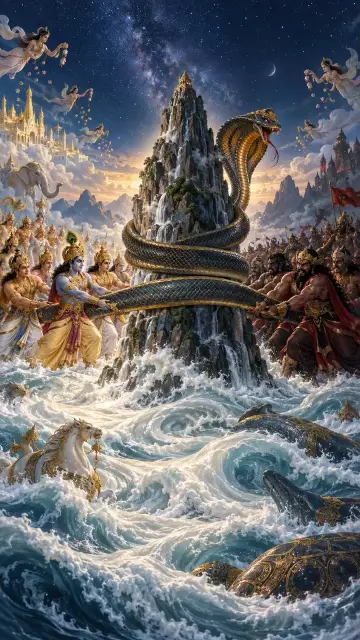
Samudra Manthan (समुद्र मंथन) is the churning of the ocean of milk by the devas and asuras to obtain amrit, the nectar of immortality. Using Mount Mandara as the churning rod and the serpent Vasuki as the rope, they first released the halahala poison, which Shiva drank, then a series of treasures including Goddess Lakshmi, and finally Dhanvantari with the pot of amrit, which Vishnu as Mohini served to the devas alone.
It is one of the most dramatic stories in the Puranas, told in the Bhagavata Purana's eighth canto, in the Vishnu Purana and in the Mahabharata. Here it is in order.
Samudra Manthan ki katha in short (संक्षेप में)
समुद्र मंथन की कथा भागवत पुराण, विष्णु पुराण और महाभारत में मिलती है। देवता अपनी शक्ति और समृद्धि खो चुके थे, तब भगवान विष्णु की सलाह पर देवताओं और असुरों ने मिलकर क्षीरसागर का मंथन किया, ताकि अमृत मिल सके। मंदराचल पर्वत मथानी बना और वासुकि नाग रस्सी, और जब पर्वत डूबने लगा तो विष्णु ने कूर्म अवतार लेकर उसे अपनी पीठ पर थामा। सबसे पहले हलाहल विष निकला, जिसे भगवान शिव ने पी लिया और नीलकंठ कहलाए। फिर लक्ष्मी समेत अनेक रत्न निकले, और अंत में धन्वंतरि अमृत कलश लेकर आए, जिसे मोहिनी रूप में विष्णु ने केवल देवताओं को पिलाया।
Samudra Manthan kyon hua tha? Why the ocean was churned
The devas had lost their strength and their prosperity, and the asuras were winning. In the Vishnu Purana, the cause is the curse of the sage Durvasa on Indra, who had treated a garland the sage gave him with disrespect. The devas went to Vishnu, who advised them to make peace with the asuras for a while and churn the Kshira Sagara, the ocean of milk, for amrit.
How was the ocean churned?
They needed a churning rod and a rope big enough for an ocean. The rod was Mount Mandara. The rope was Vasuki, king of serpents, wound around the mountain. The devas held one end and the asuras the other, and they pulled back and forth.
When the mountain began to sink into the ocean floor, Vishnu took the form of Kurma, a giant tortoise, and held it up on his back.
Why did Shiva drink the poison?
The first thing the ocean produced was not nectar but halahala, a poison so strong that its fumes began to burn the three worlds. The devas and the Prajapatis ran to Shiva. Out of compassion he gathered the poison in his palm and drank it. It stayed in his throat and turned it blue. In the popular telling, Parvati held his throat so the poison would go no further.
That is why Shiva is called Neelkanth (नीलकंठ), the blue-throated one.
Samudra Manthan 14 ratna list: what came out of the ocean?
As the churning continued, wonders rose from the milk. Lists vary between texts, and popular tradition counts fourteen ratnas, but the Bhagavata Purana names these:
- Kamadhenu, the wish-fulfilling cow, taken by the sages
- Uchchaihshravas, the white horse, taken by Bali, king of the asuras
- Airavata, the white elephant that became Indra's mount
- The Kaustubha gem, worn by Vishnu
- The Parijata tree and the apsaras
- Goddess Lakshmi, who chose Vishnu as her eternal companion
- Varuni, goddess of wine, taken by the asuras
- Dhanvantari, physician of the gods, carrying the pot of amrit
The list of 14 ratna most often given in popular tradition is: the halahala poison, Kamadhenu, Uchchaihshravas, Airavata, the Kaustubha gem, the Kalpavriksha, the apsara Rambha, Goddess Lakshmi, Varuni, the Moon, the Parijata tree, the Panchajanya conch, Dhanvantari and the amrit. Different texts and regions swap a few names, so you will see slightly different lists.
How did Mohini distribute the amrit?
The moment Dhanvantari appeared, the asuras snatched the pot and began fighting over it. Vishnu then took the form of Mohini, an enchantress so beautiful that the asuras stopped quarrelling and agreed to let her share out the nectar. She seated the devas and asuras in two rows and served only the devas.
How were Rahu and Ketu created?
One asura, Rahu, disguised himself as a deva and sat in the devas' row, between the Sun and the Moon. He had just swallowed the nectar when they recognised him. Vishnu's Sudarshana chakra cut off his head, but the amrit had already reached his throat, so the head lived on as Rahu and the body as Ketu. Tradition says this is why Rahu chases the Sun and Moon, causing eclipses.
What does Samudra Manthan teach?
Many people read Samudra Manthan as a picture of any great effort:
- You may have to work with people you disagree with to reach something worth having.
- The poison usually comes out before the reward. Hard beginnings are part of the process, not a sign of failure.
- Someone has to hold the poison for everyone else. Shiva's act is the image of anyone who quietly absorbs a hardship so others can go on.
- Steady support matters. Without Kurma under the mountain, the whole effort would have sunk.
Watch the story in one minute a day
The churning of the ocean, from Neelkanth to Mohini, is told as one-minute Hindi episodes in the Divya Katha app, each one a small lesson in patience and teamwork. For another of Vishnu's appearances in the Bhagavata Purana, read Prahlad and Narasimha, and for why these stories are still worth knowing, see why ancient stories matter.
Questions people ask
Why was Samudra Manthan done?
The devas had lost their strength and prosperity and were losing to the asuras. On Vishnu's advice they made a truce with the asuras and churned the ocean of milk together to obtain amrit, the nectar of immortality.
What came out of Samudra Manthan?
Lists differ between texts. The Bhagavata Purana names the halahala poison first, then Kamadhenu, the horse Uchchaihshravas, the elephant Airavata, the Kaustubha gem, the Parijata tree, the apsaras, Goddess Lakshmi, Varuni, and finally Dhanvantari carrying the pot of amrit. Popular tradition counts fourteen ratnas.
Why is Shiva called Neelkanth?
When the deadly halahala poison rose from the ocean and began to burn the worlds, Shiva drank it out of compassion. It stayed in his throat and turned it blue, so he is called Neelkanth, the blue-throated one.
Which avatar of Vishnu held up Mount Mandara?
When Mount Mandara began to sink into the ocean, Vishnu took the form of Kurma, a giant tortoise, and held the mountain on his back.
What are the 14 ratnas of Samudra Manthan?
The list most often given in popular tradition is the halahala poison, Kamadhenu, Uchchaihshravas, Airavata, the Kaustubha gem, the Kalpavriksha, the apsara Rambha, Goddess Lakshmi, Varuni, the Moon, the Parijata tree, the Panchajanya conch, Dhanvantari and the amrit. Texts differ slightly in which items they name.
Which snake was used as the rope in Samudra Manthan?
Vasuki, king of the serpents, was wound around Mount Mandara and used as the churning rope. The devas held one end and the asuras the other.