Divya Katha
Nachiketa is the boy in the Katha Upanishad who was given to Death by his own angry father, waited three nights at Yama's door without food, and was offered three boons. For the third, he refused every pleasure Yama offered in exchange and insisted on learning what happens after death, and Yama taught him that the true Self is never born and never dies.
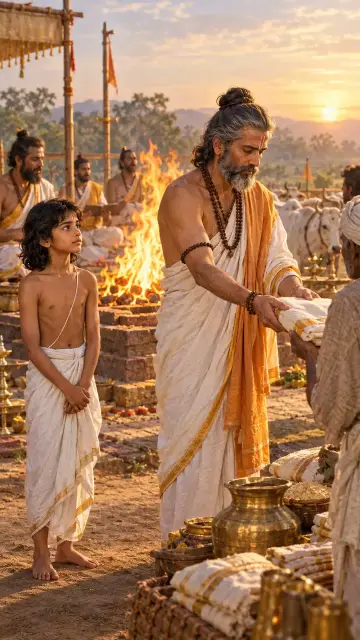
The Katha Upanishad opens not with a sage, but with a child asking an uncomfortable question. Nachiketa's conversation with Yama, the lord of death, is one of the oldest and clearest teachings in Indian philosophy, and it is told as a story anyone can follow.
Nachiketa ki kahani in short (संक्षेप में)
नचिकेता की कहानी कठोपनिषद में आती है। ऋषि वाजश्रवा यज्ञ में बूढ़ी और दूध न देने वाली गायें दान कर रहे थे, तो बालक नचिकेता ने पूछा कि आप मुझे किसे देंगे। क्रोध में पिता ने कहा, मैं तुम्हें मृत्यु को देता हूँ। नचिकेता यमराज के द्वार पर तीन रात बिना अन्न और जल के प्रतीक्षा करते रहे, और बदले में यम ने उन्हें तीन वरदान दिए। तीसरे वर में नचिकेता ने हर सुख ठुकराकर मृत्यु का रहस्य पूछा, और यमराज ने सिखाया कि आत्मा न जन्म लेती है, न मरती है।
Who was Nachiketa? (नचिकेता कौन था)
Nachiketa was the son of the sage Vajashravas. His father performed a great sacrifice in which he was meant to give away all his possessions. But the cows he gave were old and worn out: the Upanishad says they had drunk their last water, eaten their last grass and given their last milk. Young Nachiketa saw that a gift of useless things was no gift at all.
So he asked his father, "To whom will you give me?" (मुझे किसे दोगे?) He asked a second time, and a third. Finally, in anger, his father said: "I give you to Death."
Nachiketa aur Yamraj: why did Nachiketa go to Yama?
Nachiketa took his father at his word and went to the house of Yama. Yama was away, and the boy waited at his door for three nights without food or water. When Yama returned he was troubled that a brahmin guest had been left unwelcomed in his house, and he offered Nachiketa three boons, one for each night.
What were the three boons of Nachiketa?
- Peace with his father. Nachiketa asked that his father's anger be calmed and that he be welcomed home. Yama granted it at once.
- The fire that leads to heaven. He asked to learn the sacred fire ritual. Yama taught it, and was so pleased with the boy that he named the fire after him.
- What happens after death? When a person dies, some say he still exists and some say he does not. Nachiketa wanted to know the truth.
Yama tried hard to avoid the third question. He offered long life, sons and grandsons, cattle, gold, kingdoms and celestial music instead. Nachiketa refused every one: all of these wear out, he said, so keep them. Only then did Yama agree to teach him.
What is shreyas and preyas?
Yama's first lesson is one people still quote. There are two paths in life. Preyas (प्रेय) is what is pleasant now. Shreyas (श्रेय) is what is good in the end. Both approach a person; the wise choose shreyas, while the foolish choose preyas and lose their way. Nachiketa had already shown which he would choose, by refusing every pleasure Yama offered.
What is the chariot in the Katha Upanishad?
The Katha Upanishad also gives one of the most famous images in Indian thought. The body is a chariot. The senses are the horses. The mind is the reins. The intellect is the charioteer, and the true Self, the atman, is the master riding inside. A person whose charioteer holds the reins firmly reaches the goal; one whose horses run wild does not.
Yama teaches that the Self is not born and does not die, and is not killed when the body is killed. The same idea appears again, in almost the same words, in the second chapter of the Bhagavad Gita.
Why children love Nachiketa's story
Nachiketa is brave, honest and stubborn in the best way. He notices when grown-ups are not being fair, he keeps his word, and he does not let anyone, not even Death, distract him with gifts. It is a wonderful story to share with children who ask big questions, and with adults who have stopped asking them.
Watch the story in one minute a day
Nachiketa's story is told in his own voice, from his father's gift to his return home, as one-minute Hindi episodes in the Divya Katha app, a way to learn the Upanishad's questions one minute at a time. To see how the same teaching about the undying Self returns on the battlefield of Kurukshetra, read Bhagavad Gita lessons for daily life, and for another conversation with Yama, the story of Savitri and Satyavan.
Questions people ask
Who was Nachiketa?
Nachiketa is the boy at the centre of the Katha Upanishad. He was the son of the sage Vajashravas. After his father angrily said he would give him to Death, Nachiketa went to Yama's house, waited three nights, and received three boons, the last of which was the teaching about the Self.
What were Nachiketa's three boons?
First, that his father's anger be calmed and that he be welcomed home. Second, the knowledge of the sacred fire that leads to heaven, which Yama named the Nachiketa fire. Third, the truth about what happens to a person after death.
What is the difference between shreyas and preyas?
In the Katha Upanishad, Yama says preyas is what is pleasant now and shreyas is what is good in the end. The wise choose shreyas; those who choose only the pleasant miss the goal.
What is the chariot analogy in the Katha Upanishad?
Yama compares the body to a chariot, the senses to its horses, the mind to the reins, the intellect to the charioteer and the Self to the master riding inside. A person whose intellect holds the reins firmly reaches the goal.
What did Yamraj teach Nachiketa?
In the Nachiketa Yamraj samvad, Yama teaches that there are two paths, preyas, the pleasant, and shreyas, the good, and the wise choose the good. He compares the body to a chariot driven by the intellect with the Self as its master, and teaches that the Self is not born, does not die, and is not killed when the body is killed.
Which Upanishad tells the story of Nachiketa?
The story of Nachiketa is told in the Katha Upanishad, also called the Kathopanishad, which belongs to the Krishna Yajurveda. A shorter version of the story also appears in the Taittiriya Brahmana.