Divya Katha
The best Hindu mythology stories in Hindi with moral are short scenes from the Mahabharata, Ramayana and Puranas that each carry one clear lesson (शिक्षा): Ekalavya teaches dedication, Shravan Kumar serving your parents, Ganesha's walk around his parents wisdom over speed, Karna generosity, Bhishma the weight of a promise, Shabari patient devotion, and Jatayu doing right even when you cannot win.
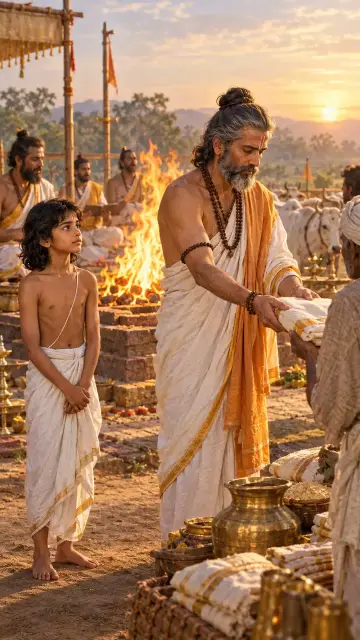
These are pauranik kahaniyan (पौराणिक कहानियां) that Indian families have told for centuries. Each one below is a few lines long, names the text it comes from, and ends with its moral. For a different set of twelve, aimed at bedtime, see Indian mythology stories for kids.
Pauranik kahaniyan in Hindi, with their shiksha
1. Ekalavya ki kahani: guru ke prati samarpan
Ekalavya, a young Nishada, asked Dronacharya to teach him archery and was turned away. He made a clay image of Drona in the forest and practised before it every day until he was a finer archer than Arjuna. When Drona found out, he asked for his right thumb as guru dakshina, and Ekalavya cut it off without a word. From the Mahabharata's Adi Parva.
शिक्षा (Moral): dedication can teach you what no one will. And a question worth asking children: was Drona fair?
2. Shravan Kumar: maata-pita ki seva
A young ascetic carried his blind, aged parents on his shoulders and went to fetch them water from the river at night. King Dasharatha, hunting, heard the pot filling, mistook it for an animal and shot him. The grieving parents cursed the king to die in grief for his own son, as he later did when Rama left for the forest. The story is in the Valmiki Ramayana's Ayodhya Kand, where the boy is unnamed; the name Shravan Kumar comes from later tradition.
शिक्षा: serving your parents is a duty, and a careless act can hurt people you never see.
3. Ganesh aur Kartikeya ki daud: buddhi bal se bada
Shiva and Parvati said that whichever son went round the whole world first would be married first. Kartikeya set off at once on his peacock. Ganesha calmly walked around his parents and bowed, saying that for a son, his parents are the whole world. He was declared the winner. Told in the Shiva Purana.
शिक्षा: think before you run; wisdom beats speed.
4. Karna ka daan: kavach aur kundal
Karna was born with armour and earrings that made him nearly invincible. Indra, father of Arjuna, came to him disguised as a brahmin at the hour when Karna never refused anyone, and asked for them. Karna knew who he was and cut them from his body anyway. From the Mahabharata's Vana Parva.
शिक्षा: a giving heart does not bargain, even when giving costs everything.
5. Bhishma pratigya: vachan ka mol
Prince Devavrata gave up the throne and vowed never to marry so that his father Shantanu could marry Satyavati. For that terrible vow he was called Bhishma, and he kept it all his life, even when it held him on the wrong side at Kurukshetra. Read the full Mahabharat ki kahani (in Hindi).
शिक्षा: a promise has weight; make yours wisely, because you will have to keep them.
6. Shabari ki kahani: dhairya aur bhakti
Shabari, a forest woman, served the sage Matanga, who told her that Rama would one day come to her ashram. She waited for years and grew old waiting. When Rama finally came, she welcomed him with fruits she had gathered. From the Valmiki Ramayana's Aranya Kand; the well-known detail that she tasted each berry first, so Rama would only get the sweet ones, comes from later devotional tradition.
शिक्षा: pure love and patience matter more than rank or ritual.
7. Jatayu: sahi ke liye ladna
Old Jatayu, king of the vultures, saw Ravana carrying Sita away through the sky. He knew he could not win, and he fought anyway, until Ravana cut off his wings. He lived just long enough to tell Rama which way Sita had been taken. From the Valmiki Ramayana. Read the full Ramayan ki kahani (in Hindi).
शिक्षा: do what is right even when you cannot win.
8. Yaksha prashna: nyay aur dharma
In the forest, four Pandavas drank from a lake without answering the questions of the Yaksha who guarded it, and fell dead. Yudhishthira answered every question. Offered the life of one brother, he chose Nakula, Madri's son, not Bhima or Arjuna, so that each of his father's wives would have one living son. Pleased, the Yaksha (Dharma himself) revived all four. From the Mahabharata's Vana Parva.
शिक्षा: fairness means thinking of others, not only of your own side.
9. Arjuna aur chidiya ki aankh: dhyan
Dronacharya set a wooden bird on a tree and asked each student what he saw. One saw the tree, another the branches, another his brothers. Arjuna said he saw only the bird's head, and Drona let only him shoot. From the Mahabharata's Adi Parva.
शिक्षा: focus on your goal and the rest falls away.
10. Ram Setu ki gilahari: chhota yogdan bhi bada
While the vanaras hauled boulders into the sea to build the bridge to Lanka, a little squirrel rolled in the sand and shook it off between the stones. Rama lifted it gently and stroked its back, and folk tradition says the three stripes on a squirrel's back are his fingers. This is a folk story, not in Valmiki, but it is told all over India.
शिक्षा: no help is too small when the work is good.
11. Bhima aur budha vanar: vinamrata
Proud Bhima found an old monkey lying across his path and told it to move. The monkey said it was too weak and asked Bhima to lift its tail himself. Bhima could not move it at all. The monkey was Hanuman, Bhima's elder brother, as both were sons of Vayu. From the Mahabharata's Vana Parva. More about Hanuman: Hanuman in the Sundar Kand.
शिक्षा: strength without humility is weakness; never look down on anyone.
12. Yudhishthira aur kutta: vafadari
At the very end of the Mahabharata, the Pandavas walk towards the Himalayas and fall one by one. Only Yudhishthira and a dog that had followed him all the way reach heaven's gate. Indra invites him in but says the dog must stay. Yudhishthira refuses to abandon a creature that trusted him. The dog turns out to be Dharma, testing him. From the Mahaprasthanika Parva.
शिक्षा: loyalty to those who depend on you is worth more than heaven.
Dharmik kahaniyan for kids: how to tell them
- One story, one shiksha. End with a single question: "Aap hote toh kya karte?" (What would you have done?)
- Don't hide the hard parts. Ekalavya and Karna are not neat. Older children love arguing about whether Drona or Indra were fair.
- Name the source. Saying "this is from the Mahabharata" teaches children that these stories have a home they can return to.
For why stories like these matter at all, read why ancient stories still matter.
Watch these pauranik kahaniyan, one minute at a time
Many of these stories are told as one-minute Hindi episodes in the Divya Katha app, each with its own lesson to learn. Watch one together, then ask about its shiksha.
Questions people ask
What are some Hindu mythology stories in Hindi with moral?
Well-loved ones include Ekalavya (dedication), Shravan Kumar (serving parents), Ganesha circling his parents (wisdom over speed), Karna giving away his armour (generosity), Bhishma's vow (the weight of a promise), Shabari (patient devotion), Jatayu (doing right even when you cannot win), Yudhishthira and the Yaksha (fairness), Arjuna and the bird's eye (focus), the squirrel at Ram Setu (no help is too small), Bhima and the old monkey (humility) and Yudhishthira's dog (loyalty).
What is the difference between pauranik kahaniyan and dharmik kahaniyan?
Pauranik kahaniyan are stories from the Puranas and the epics, such as the Bhagavata, Shiva Purana, Mahabharata and Ramayana. Dharmik kahaniyan is a wider everyday phrase for any religious or devotional story, including these as well as folk tales and saints' lives.
Are all these stories in the original scriptures?
Most are. Ekalavya, Karna, Bhishma, the Yaksha, the bird's eye, Bhima and Hanuman, and Yudhishthira's dog are in the Mahabharata; Jatayu and Shabari are in the Valmiki Ramayana; Ganesha's race is told in the Shiva Purana. The squirrel at Ram Setu and Shabari's tasted berries come from later folk and devotional tradition, and the name Shravan Kumar is from later tradition too.
Which of these dharmik kahaniyan are good for kids?
For young children, start with Ganesha and Kartikeya, the squirrel at Ram Setu, Shravan Kumar, Arjuna and the bird's eye and Jatayu. Ekalavya and Karna are better for older children, because they invite a discussion about fairness.